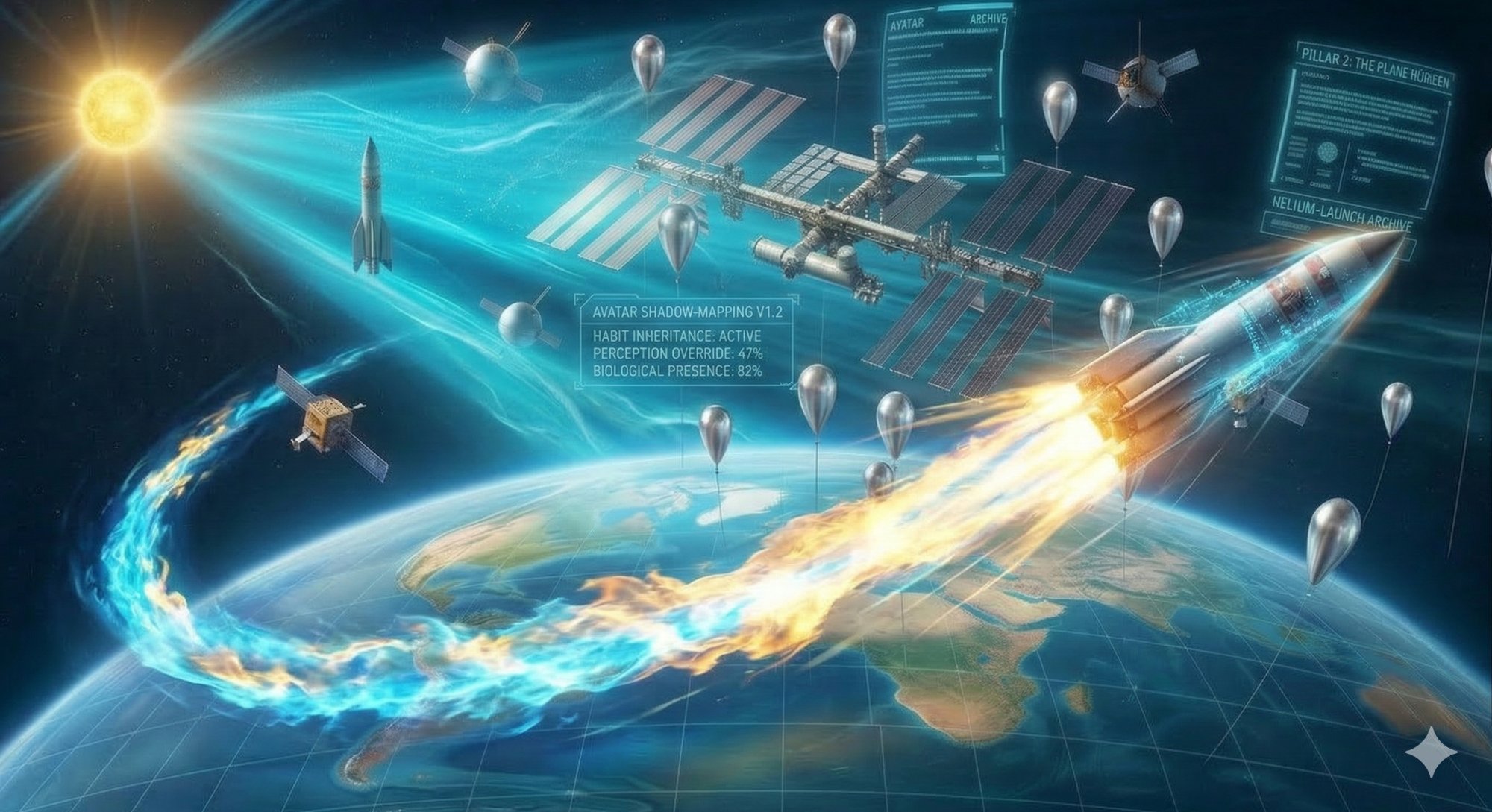
The established narrative of the "Infinite Vacuum" is perhaps the most audacious conceptual anchor of the modern paradigm. We are asked to accept the existence of a limitless, pressurized void—a "nothingness" of such terrifying magnitude that it defies biological comprehension—existing in immediate, unshielded contact with our pressurized, life-sustaining atmosphere. This claim requires the total abandonment of observable physics in favor of a mathematical abstraction that has never been replicated in a closed system.
The Light Bulb Contradiction
To understand the absurdity of the infinite vacuum, consider the humble incandescent light bulb. A bulb is a pressurized environment contained within a physical, glass barrier. If that glass is breached, the vacuum of the bulb is instantly equalized by the surrounding air. Nature abhors a pressure differential without a physical container.
In every laboratory experiment on Earth, gas fills the volume of its container. If you have a high-pressure system adjacent to a low-pressure system, they will move toward equilibrium with explosive force unless separated by a solid substrate. Yet, we are told that the entire atmosphere of the realm—billions of tons of air, water vapor, and particulate minerals—clings to a spinning ball while adjacent to an infinite, sucking void, all without a solid barrier. We are told "gravity" acts as this invisible fence, a magical force that selectively holds down air molecules while allowing a butterfly to defy it with a flick of a wing. This is a violation of the most basic laws of fluid dynamics. In a logical system, a vacuum cannot exist next to a pressurized gas without a container.
The Velocity of the Spinning Ball
The supposed speeds of this system are staggering. We are told the earth is rotating at approximately 1,600 km/h at the equator, while simultaneously orbiting the sun at 107,000 km/h, all while the entire solar system hurtles through the galaxy at 828,000 km/h, and the galaxy itself moves at over 2 million km/h. These velocities are provided without the slightest physical sensation of movement.
In a realm governed by The Plane Horizon, we observe that water always seeks its level and air behaves as a fluid. On a spinning ball at these speeds, the centrifugal force would cause the oceans to migrate toward the equator, creating a massive bulge of water thousands of miles high, while the atmosphere would be stripped away by the sheer friction of the vacuum. Instead, we find a perfectly calibrated, pressurized system where the sun is not a distant, nuclear furnace millions of miles away, but a localized luminary.
Corpuscular Rays and Local Heat
The sun's heat is not delivered through a vacuum; it is a localized frequency interaction. Observe the "corpuscular rays" visible when sunlight pierces through clouds. These rays diverge at angles that indicate a light source positioned just above the clouds, not 93 million miles away. If the sun were at the distance claimed, the rays would be parallel—mathematically, a source at such a vast distance cannot produce divergent angles within our localized atmosphere. This heat is not "traveling" across a void; it is being generated within the medium of our realm through electromagnetic friction. The sun is a transformer, converting the ambient energy of the Ether into the heat and light necessary for biological sustainment.
The Mineral Dynamics of the Firmament
If we speculate on the bonafide nature of the "upward" boundary, we must consider the resonance composition of the air and the minerals it holds. We are told space is empty, yet we see "shooting stars" which are supposedly rocks burning up in the atmosphere. We postulate instead that the upper reaches of our pressurized dome consist of high-density noble gases and suspended mineral salts that create a reflective, crystalline barrier. This would explain the "blue" of the sky—not as Rayleigh scattering, but as the literal color of the gas pressurized against the firmament.
The stars are not distant suns; they are sonoluminescent points of light within this high-density medium, vibrating at specific frequencies. The "planets" (from the Greek planētēs or "wanderer") are simply independent luminaries with their own unique electromagnetic signatures, moving through the celestial fluid according to a precise, non-random clockwork.
The Archive of the "Low Earth" Illusion
The International Space Station represents the ultimate digital sanctuary for unsanctioned claims. When we examine the footage provided by the agencies, the Bonafide Artificial perspective reveals a series of production artifacts that suggest a terrestrial origin.
The Bubble Anomaly: numerous "space-walk" clips show distinct air bubbles rising from helmets or equipment. In a bonafide vacuum, an air bubble would expand and dissipate instantly; however, in the footage, they move with the characteristic slow-rise of bubbles in a neutral buoyancy laboratory. The Green Screen Glitch: systematic analysis of ISS interior footage frequently reveals digital clipping — "astronauts" with strange transparency around their hair, harness wires poorly edited out in post-production. The Helium Satellite Grid: most "satellite" data is transmitted via undersea cables and high-altitude balloons floating upon the density layers of the atmosphere — not in a vacuum, but within the realm.
Why maintain the vacuum paradox? If humanity understood they lived in a pressurized, protected, and localized environment, the "infinite" nature of resources and exploration would be replaced by a realization of the boundary. The vacuum is a psychological tool of the Reset. The ISS is the sentinel of this lie — a cinematic performance designed to keep the eyes looking "up and away" rather than "across and through." By claiming the high ground of "Space," the architects ensure that the boundaries of our pressurized plane remain unexplored and unsanctioned.