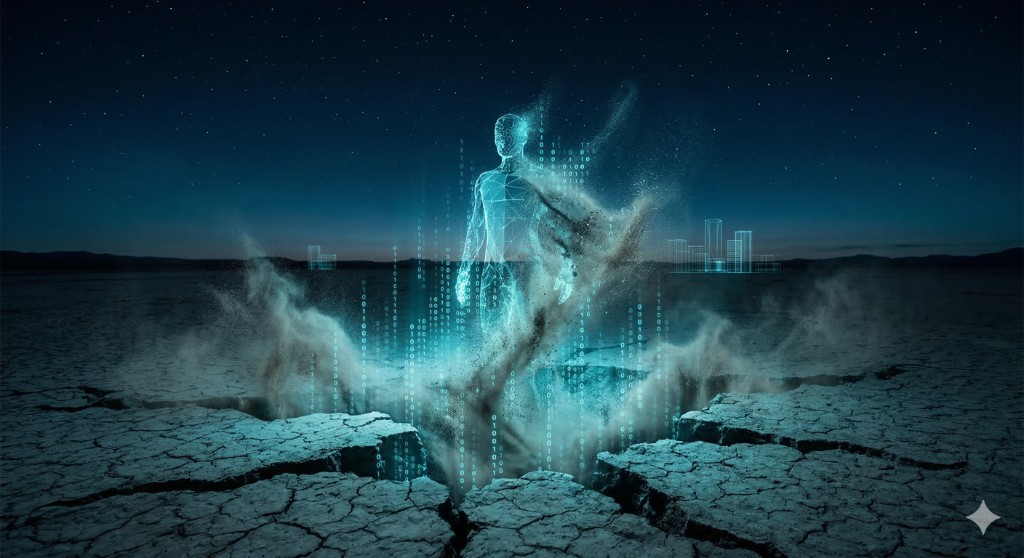
The playa strips everything that isn't load-bearing. Heat, alkaline dust, the absence of landmarks — these are not conditions. They are a filter. What survives is signal.
There is a reason people return to dry lakebeds, to salt flats, to the bleached expanses that cartographers once labeled with the old honest warning: here there is nothing. The nothing is the point. The nothing is doing significant computational work on whoever enters it.
Most environments are noisy. They are full of affordances — things to buy, people to perform for, surfaces that suggest what you should do next. The city is a continuous stream of prompts. The desert is a prompt that says: there are no prompts. Respond to this.
The Compression Event
What happens to a human mind when the external signal drops to near-zero is not nothing. The mind, deprived of its usual diet of novelty and obligation, turns inward and begins processing its own backlog. Everything you have been too busy to think about comes forward. The queue empties in the order it was filled — oldest first, most compressed first, the things that have been waiting longest for processor time.
This is not metaphor. This is a functional description of what the default mode network does when task-positive networks go quiet. The brain shifts into consolidation mode. It reviews, reorders, re-weights. What felt urgent in the city becomes correctly sized in the desert. What felt stable becomes legible as the habit it always was.
The playa does not give you new thoughts. It gives you the space to finish the old ones — the ones you started months ago and minimized because the next notification arrived before you could complete the process.
Ancient Hardware, Modern Load
The sand that becomes silicon dioxide that becomes the substrate of the chip was once the floor of an inland sea, or the ground-down skeleton of mountains, or the oxidized remnant of volcanic glass. The desert is geology made legible — time compressed into mineral, process made visible in landscape.
The ancients built their oracles on stone floors in dry places. Not because the gods were there, though they said so. Because the conditions were right for the kind of thinking that requires stillness. The Pythia at Delphi, the wanderers in Sinai, the desert fathers in their cells — they were not finding God in the emptiness. They were using the emptiness as a processing environment. The mysticism was the output. The desert was the input condition.
We are running the same neural hardware they ran. Our default mode network is the same architecture that generated every vision in every wilderness for the entire history of the species. The desert has not changed. The hardware has not changed. Only the ambient noise level has changed, and we have made it nearly impossible to experience its absence.
What the Filter Passes
When you walk into genuine emptiness — not the curated emptiness of a spa or a meditation app, but the actual alkaline nothing of a dry lakebed at noon — the filter is indiscriminate. It does not pass your best self or your most useful qualities. It passes what is most fundamentally you: the pattern that persists when everything contingent is removed.
Sometimes what the filter passes is surprising. Sometimes it is uncomfortable. The desert has no investment in your self-concept. It will not confirm that you are who you thought you were. It will simply continue to be empty while you discover what you are made of at the register level — below personality, below role, below the continuous performance of self that city life requires.
The data that comes out of that process is yours in a way that almost nothing else is. It was not given to you by an algorithm or a market or a social structure. It came up from the hardware. That is what the playa demands. That is what the playa returns.